
Bed bug signs: how to be sure before you treat
A diagnostic guide to bed bugs in Egypt: the insect at all five stages, the dark spots in the seam, the shed skins, how bites line up, and how fleas differ.
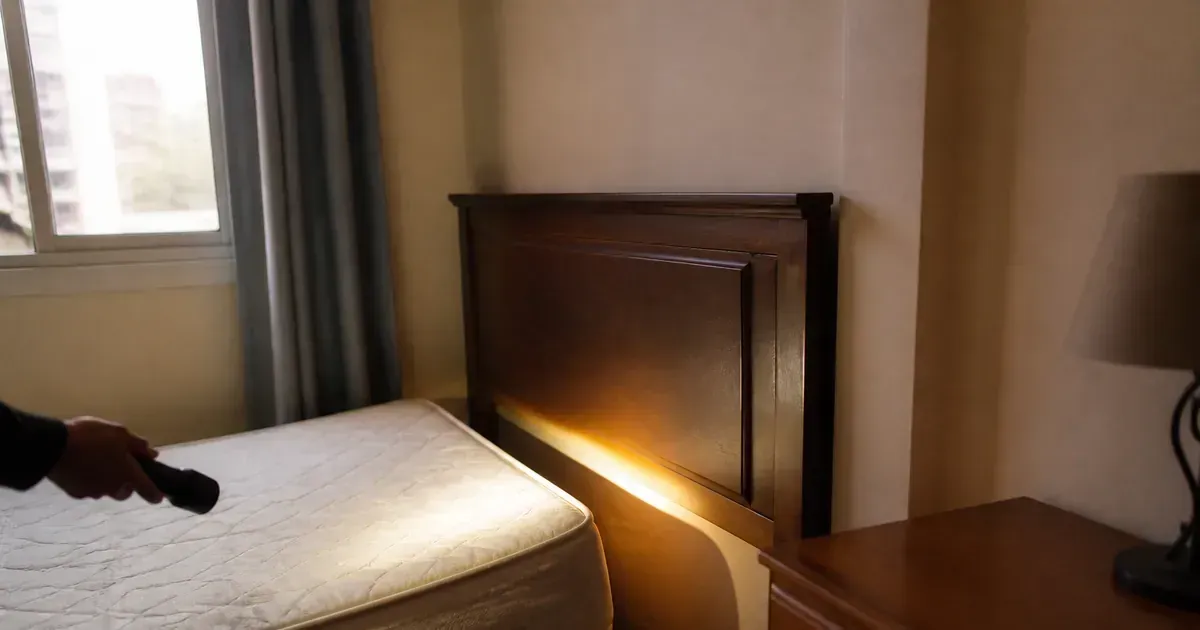
Bed bugs feed while you sleep and are back in the crack before you open your eyes. The insect spends more than 90% of its life folded into a narrow gap in something you assumed was solid and sealed, coming out for a few minutes every two or three days. That is why people see the evidence first and the insect last.
And that evidence gets read correctly, or it gets read wrong. The pattern that repeats on our calls: someone changes the laundry detergent, then buys an antihistamine cream, then fits a mesh screen on the window — and still wakes up with something new on their skin. Every one of those steps would have been the right one if the diagnosis had been right.
This page works through the signs one at a time: what the insect looks like at each stage, what it leaves on fabric and why it leaves it in that shape, how to inspect the bed with your own hands, and which other insects get mistaken for it.
What are the signs of bed bugs?
There are five: bite marks on skin that was uncovered while you slept, small blood spots on fabric, dark spots clustered inside the folds of a seam, light transparent shells in the same folds, and a heavy sweetish smell in a room with a large infestation.
Those five signs do not carry equal diagnostic weight, and that is the most important thing to know before you read any further. Two of them say “yes” on their own. The other three only say “keep looking.”
| Sign | Where it usually is | Weight |
|---|---|---|
| Dark spots inside folds and seams | The mattress seam, the back face of the headboard | Decisive |
| Shed skins | The same folds, the mattress corners | Decisive |
| Blood spots on fabric | The strip beside the mattress edge | Strong |
| Bite marks on skin | Arm, shoulder, neck, leg | Supporting |
| A sweetish smell | A closed bedroom, a large infestation | Supporting |
Keep that order of weight in mind while you inspect. What defeats most people is that they start at the skin and finish at the skin.
What do bed bugs look like to the naked eye?
An adult bed bug is a flat oval insect 4 to 5 mm long and reddish brown — roughly the size of an apple seed, and visible without a lens. The problem is that the younger stages, which make up most of the numbers in any infestation, are transparent and much smaller.
Its body is flattened top to bottom to an extreme degree, and that is not a cosmetic detail — it is what lets the insect settle comfortably into a gap less than a millimetre and a half wide. After feeding, the abdomen swells, lengthens and turns dark red, so an insect you see after a meal can be twice the size of the hungry one next to it.
| Stage | Length | Colour | Visibility |
|---|---|---|---|
| Egg | 1 mm | Pearly white | Hard — looks like a grain of salt |
| First nymph | 1.5 mm | Yellowish translucent | Almost nil before feeding |
| Second and third nymph | 2 to 3 mm | Beige | Possible with a torch |
| Fourth and fifth nymph | 3 to 4.5 mm | Light brown | Clear |
| Adult | 4 to 5 mm | Reddish brown | Clear to the eye |
The insect has six legs, four-segmented antennae, and a fine proboscis folded under the head that only extends while feeding. On the front of its back there is a pair of small flattened pads — the remains of wings that shrank away across the evolution of the whole family, with no flight function whatsoever.
There is a second species that shares the same homes in hot regions: the tropical bed bug. The difference between it and the common one is a detail in the width of the segment behind the head, and you need a lens to see it. In practice that is a taxonomic difference rather than a treatment one: both hide in the same places and are handled the same way, and the tropical one simply tolerates slightly higher temperatures — which makes it comfortable in an Egyptian summer.
Do bed bugs fly or jump?
Bed bugs neither fly nor jump at all, and that is the fastest test for separating them from half the insects they get confused with. Their top speed is a walk of about a metre per minute on a flat surface.
Practically, this insect reaches you either by walking a short distance or by being carried. There is no third option. Anyone who tells you it comes in through the window like a mosquito is working from wrong information, and that distinction comes back at the end of this page when we get to how they enter.
And how does it differ from the bat bug?
The bat bug is from roughly the same genus and looks very close to a bed bug with the naked eye. The difference is longer hairs on the edge of the segment behind the head — longer than the diameter of the insect’s own eye.
That matters in a real way in a building with a blocked ventilation shaft or an old collapsed ceiling holding a bat colony. If the source is bats, the insects come down from above rather than up from the bed, and the real work becomes sealing the original animal’s entry point. It is a rare case in modern flats and much more common in older buildings with timber roofs.
What do bed bug bites look like and where do they appear?
A bed bug bite is a small red swelling with a darker point at its centre, and it appears on skin that was uncovered while you slept: the arm, the shoulder, the side of the neck, the leg. Its most distinctive feature is that the marks arrive in a line, or in a small tight group in one spot.
The medical literature nicknames that arrangement “breakfast, lunch and dinner” — a wry label that describes exactly what happens. The insect finds a blood vessel, feeds, shifts slightly, tries again. Each attempt leaves a mark, so what you are seeing on your arm may be the stops of a single insect along its route.
Feeding itself takes three to ten minutes, and the saliva contains a local anaesthetic and a second compound that stops the blood clotting. Those two are why you do not wake up during the bite at all — the insect numbs the point before it pierces it.
Why do the bites come in a line?
The bites arrive in a line because the insect moves as it hunts for a capillary, leaving a mark at each attempt along the path it walked on your skin.
Which means what you are looking at is a track with a direction, and that direction starts from a particular side of the bed. If the line is always on your right arm and you sleep on your left side, start the inspection at the edge nearest that arm. Details like this save real time.
Why does one person get bitten and their partner in the same bed does not?
This comes up in most households, and the reason is that skin response varies enormously between individuals. Both people can be bitten on the same night and the mark appears on only one of them.
That skin reaction is a form of allergy to components of the saliva, and it needs repeated exposure before it develops. On a first-ever exposure the mark can take a week or more to appear; after months of daily exposure it can show within hours. And some people — a higher proportion among the elderly — have skin that stays completely silent throughout.
Which explains a scene that plays out constantly in clinics and on our calls:
— I sleep next to him and I am covered in them and he has nothing at all. — Does he wake up itching? — No, he does not feel a thing. — That is normal. The difference is in the skin, not in the bed.
So one person complaining in a household does not rule out the diagnosis, and it is not a reason to put off the inspection.
How long after the bite does the mark appear?
The delay ranges from hours to a full week depending on your history of exposure to this insect. That creates a common arithmetic error: someone says “I was bitten last night” when in fact they were bitten last week.
That error leads to wrong conclusions about location. Somebody comes back from a trip, finds bites and assumes the problem was the hotel — when the marks may be from their own bed, from days before they travelled. The only way to settle it is to leave the skin alone and go to the fabric.
The dark spots in the mattress seam: what are they?
The small dark spots you find clustered inside a seam fold, or on the back face of the headboard, are the insect’s faeces — digested blood — and this is the strongest single sign you can rely on by itself.
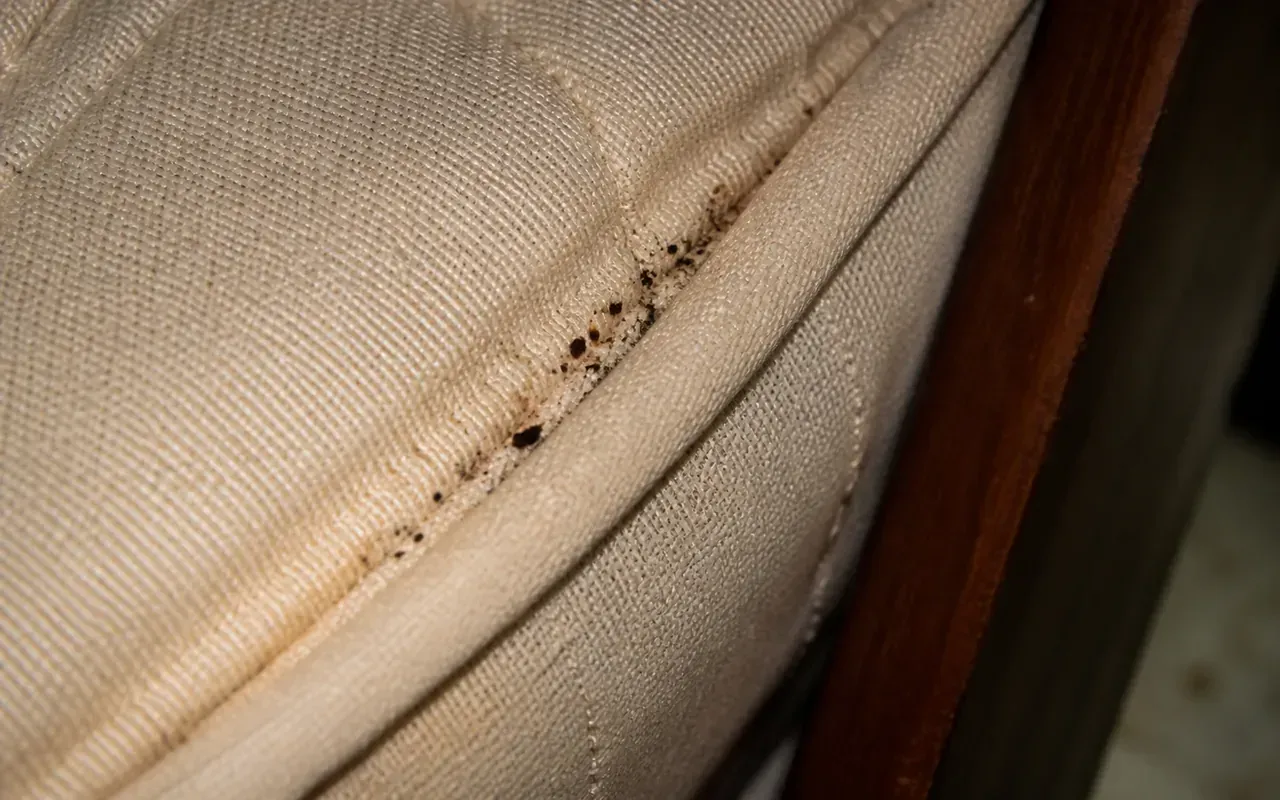
Dark spots in the mattress seam beside the bed edge — the strongest diagnostic sign on its own.
They are never spread evenly across an open surface. They pile up in one very tight spot and thin out within a few centimetres of it, because the insect empties its abdomen inside the harbourage right after it returns from feeding. That geometry — a sharp cluster in one small patch and nothing at all beside it — is half the diagnosis.
There is a second property that settles the question. The faeces are liquid when deposited, so they soak into the fibres the way ink soaks into blotting paper: the spot has a halo that fades towards its edges. To confirm, take a piece of cotton wool damp with plain water and wipe gently. If a rust-brown smear spreads into the fabric, those are faeces. Dried ink and ordinary dirt stay where they are.
| What you are seeing | How to settle it |
|---|---|
| Bed bug faeces | Clustered inside the fold, leaves a rusty smear on damp cotton |
| Dust | A grey layer spread evenly across the whole exposed surface |
| Ink | A spot or line with sharp edges that does not move with water |
| Damp mould | Circular, growing, with an earthy smell |
| Cockroach droppings | In drawers and the kitchen, dry granules sitting on the surface |
What are the transparent shells in the bed corners?
The light shells you find in those same folds are the insect’s old skin after moulting, and their presence means you have a living, growing colony in that spot — not one stray insect that passed through.
A bed bug goes through five nymphal stages before reaching adulthood, and each one ends in a moult. The condition there is no way around is that a nymph must take a full blood meal before every moult, so from egg to adult there are at least five meals. Which means a single insect that reached adulthood in your bed fed on you five times on the way there.
The shed skin keeps the insect’s full shape — the same oval, the same legs — but empty, transparent, and so light that it crumbles between your fingers with no resistance. Most people take them for crumbs, or onion skin that came in with a bag. If the patch holding the shells also holds dark spots, that is it: the diagnosis is closed and you do not need a third sign.
Do bed bugs have a smell you can identify?
Yes, and the smell has a known chemical basis. The insect has glands on both sides of the thorax that release aldehyde compounds — best known among them (E)-2-hexenal and (E)-2-octenal — whose function is to alarm other individuals and gather them back into the harbourage. Those compounds smell heavy and sweet with a green note close to fresh coriander, and people describe them as a sickly-sweet odour they cannot locate the source of. The concentration from a single insect is far below the human detection threshold, which is why the smell only becomes noticeable in a large, established infestation in a poorly ventilated room. Its presence says the problem has been running for a while. Its absence says nothing whatsoever.
Where do bed bugs hide inside a flat?
A bed bug picks the narrowest gap that touches it on two sides, as close as possible to where you sleep, and most individuals in any infestation sit within a metre and a half to two metres of the head of the bed. Distance from the sleeper decides their position in the flat before any other factor.
The insect has a strong preference for contact on two sides — it wants its back and its belly against a surface at the same time — so it favours thin cracks over any open space. It prefers rough materials such as wood, paper and fabric over smooth metal and plastic. And its own faeces act as a chemical marker that gathers individuals into the same harbourage, so the infestation stays piled into a handful of points with completely empty stretches between them.
The practical map, ordered by how often it produces a result:
- The long mattress seam on the side you sleep on, and the piping folds at the corners
- The back face of the headboard and the gap between it and the wall
- The joints of a wooden bed frame, screw recesses and metal corner brackets
- Under the socket cover and the light switch plate nearest the bed
- The seams of a sofa or armchair you sometimes sleep in at night
- The gap between the floor and the timber skirting directly behind the bed
- The back of a picture frame or mirror hung above the bed
Why the electrical sockets in particular?
A socket is an opening into a void inside the wall, and that void connects one flat to the next along the cable routes. Which means the wall between you and your neighbour is an open road for an insect a millimetre and a half wide.
The consequence is that inspecting only the room with the complaint leaves half the question unanswered. That is why the adjoining room is part of our inspection from the first visit, and if there is activity in it, the plan changes before anything is opened. And if the neighbours are complaining of the same thing, we say so plainly and it is counted into the number of visits before you pay anything.
How do I inspect the bed myself?
You can inspect the bed with a phone torch, an old plastic card, and a fixed order that starts at the fabric and ends at the wood. The one condition that matters most is doing it before you make the bed or wash the sheets, because cleaning erases half the evidence before you have seen it.
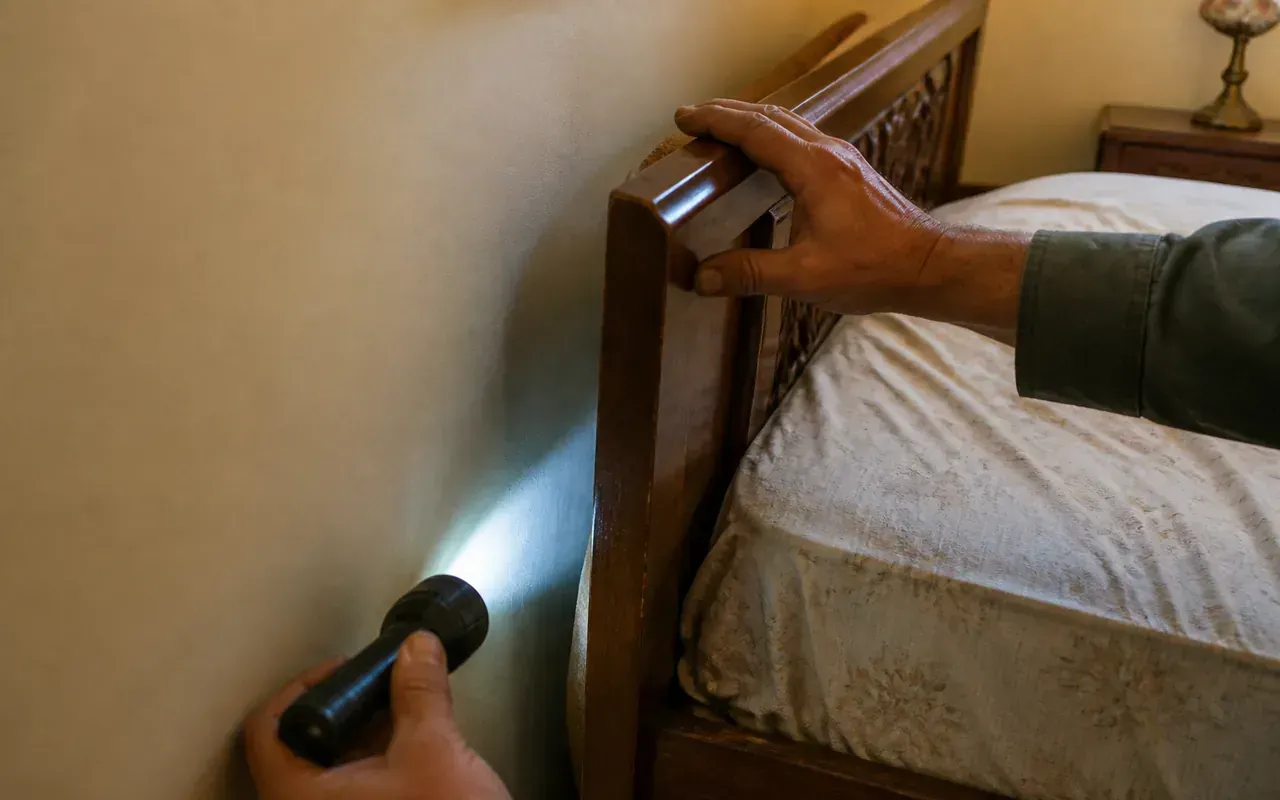
The inspection starts at the fabric: the torch at a low angle across the seam, from behind the headboard.
- Take the sheet off without shaking it, spread it out under strong light and look for small blood spots, particularly on the strip you sleep on.
- Lift the mattress edge and angle the torch low across the long seam. Raked light casts a shadow inside the fold and reveals the spots; light straight on flattens everything.
- Work through the four corners and the outer piping folds the same way, and open the fold with the edge of the card rather than your finger.
- Turn the mattress over and repeat the whole circuit on the other face, then look at the bed base or the box beneath it.
- Pull the bed away from the wall and inspect the back face of the headboard, the screw recesses, and the wall itself behind the board.
- Switch off the power at the board, open the socket cover nearest the bed and look inside with the torch.
The step that stops most people is the fifth, because it needs someone to help you move the bed. And it is precisely the step with the highest rate of a positive result: the back face of the board is dark, narrow, undisturbed, and close to your head for eight hours a day — every condition the insect looks for in a harbourage.
And if the whole inspection comes back clean while you are still waking up with new marks, the file is not closed. Read the next section, because the order above is designed for a bed and does not catch fleas at all.
What is the difference between bed bugs and fleas?
The decisive difference sits in three places: where on your body the bite is, how the insect behaves, and where it lives in the house. Bed bugs bite the uncovered parts of you and live in the bed; fleas bite from the knee down and live in the floor of the house.
| Comparison | Bed bugs | Fleas |
|---|---|---|
| Bite location | Arm, shoulder and neck | From below the knee to the ankle |
| Body shape | Flattened top to bottom | Compressed side to side |
| Movement | A slow walk | A jump many times its own length |
| Where the insect lives | Mattress seams and bed timber | The base of carpet and rug pile |
| Environmental sign | Dark spots in the seam | Black granules in the carpet that turn red with water |
| Relationship to a pet | None | Strong in most cases |
| Our gap between visits | 14 days | 10 days |
There are two tests you can run yourself in a minute. First: move the rug beside the bed, then stand and watch the floor — if small things are jumping, it is fleas and you are done. Second: take one of the black granules from the carpet and put a drop of water on it on white paper. If it leaves a red halo, those are flea faeces, and the reason is that flea larvae feed on digested blood dropped by the adults above them.
And that difference turns the treatment on its head. Flea control works on the floor, the soft furnishings and the animal’s sleeping place, and puts an insect growth regulator into the mix with the treatment, because the real job there is stopping the young stages from completing their development. The second visit is timed to day ten to catch the generation emerging from the pupae. And part of it depends on you: daily vacuuming for two weeks, because the pupa responds to vibration by opening — and only then can the product reach inside it.
So if you treat a bed when what you have is fleas, you have treated the wrong floor of the house with a product that has no business being there.
What is the difference between bed bugs and mosquitoes?
It comes down to a single sentence: a mosquito leaves evidence on your skin only; a bed bug leaves evidence on your skin and in your bed. Anyone can settle that comparison in five minutes with no experience and no tools.
| Comparison | Bed bugs | Mosquitoes |
|---|---|---|
| Sound | None | A whine that comes and goes |
| Evidence in the bed | Blood spots, dark spots, shells | None |
| Source | Bed seams and the cracks around them | Standing water nearby |
| Where it is by day | Inside the crack | A shaded wall or under the sink |
| Wings | Vestigial, does not fly | Full, flies |
The whine alone is strong evidence. Bed bugs make no sound and do not fly, so if what wakes you is a sound rather than an itch, you are on a completely different track. The second decisive sign is that mosquitoes breed in standing water, so go out to the balcony and look in the plant saucer, under the air conditioning unit and at the roof tank. There is no such thing as a bed bug breeding site on a balcony.
And be careful with a piece of advice you will hear often: a window screen stops mosquitoes and has nothing to do with bed bugs. The insect is already inside.
Could it be an allergy rather than an insect?
Very possibly, and settling it is easier than you would think: an allergy leaves marks on the skin and nothing else — not one sign on fabric or wood. If the full inspection above comes back at zero, an allergy becomes the strongest explanation.
The common mistake is trying to tell the difference from the shape of the mark itself. That road is closed from the start, because a great many things on skin look alike, to the point where dermatologists themselves do not rely on appearance alone. The open road is searching the room.
And there is a middle case that happens often: an old bite that was treated, with the mark still sitting on the skin for weeks, so the person believes the biting is continuing. What settles it is a new mark appearing on fabric that went on clean. Change the bedding completely, leave it two nights unwashed, and look at it in the morning.
We stop at our limit here plainly: we are a pest control company, not a clinic. We can tell you what is in the bed; diagnosing the skin itself is a dermatologist’s work. If the inspection is clean and the biting continues, that is the right direction.
How do bed bugs get into a home?
Bed bugs enter a home carried in something, or walking in from somewhere adjoining. The insect does not fly and moves at a metre a minute, so there is no third way in.
The carried route is usually second-hand furniture — a mattress, a sofa, a wooden bed, even an office chair — or a suitcase that sat on the floor of a hotel room or in a furniture store. And the insect survives a long time without feeding, so a case that stayed shut in a wardrobe for a month can produce something entirely alive.
The walking route comes from the adjoining unit through the cable voids described above, or from the stairwell and light wells in older buildings.
And there is an odd biological mechanism that explains why an infestation spreads within the flat itself without anything being moved. Mating in this family happens by what is called traumatic insemination: the male pierces the wall of the female’s abdomen directly rather than using the genital opening. The process injures the female and shortens her life if repeated often, so females that are mated at a high rate leave the aggregation and walk off to build a new harbourage a few metres away. Which means the bed generates a second focus in the sofa or the next room by itself, with nothing carried by human hands.
And so the picture is complete before you sign anything: our written guarantee covers the same pest returning. It does not cover a new infestation coming in from a neighbouring flat, or with second-hand furniture brought in after treatment. That is said plainly on the first visit, while you are still deciding.
Why does an over-the-counter spray fail?
A pharmacy spray fails against bed bugs for three reasons that work together: the eggs survive it, the insect avoids the treated area and moves to another room, and the product itself has become far weaker than the label suggests because of resistance.
That resistance point needs detail, because it is what explains why people who have been spraying for a year say the product “has turned to water.” These insects have built a defence on three levels: a small change in the nerve channel the product acts on, so it binds less well; a thicker outer layer to the body, so less of it penetrates; and enzymes inside the body that break the molecule apart before it reaches its target. All three are inherited by the next generation, so every failed spray selects for the resistant individuals and leaves them to breed.
The traditional group that commercial sprays are built on has become weak against the locally established strains, which is why serious work in bed bug control uses a different group, registered with the Ministry of Health, acting on a completely different pathway inside the insect. The defence it built against the first group does not protect it here.
And there are two mistakes people make in good faith that double the amount of work:
- Sleeping in the living room to escape the bedroom. The insect follows the food source, so the sofa becomes a second focus within two weeks and you have two problems instead of one.
- Carrying the mattress out to the stairwell or the car. The route the mattress travelled becomes a transport route in its own right: the stairs, the lift, and the boot of the car.
The rule we give every client before the visit is to keep sleeping where they are and leave the furniture in place until the technician has seen the situation. That is the opposite of everyone’s first instinct.
The bed bug life cycle and why it decides the number of visits
The egg hatches after 7 to 12 days at ordinary room temperature, and throughout that period it is protected by a hard shell glued to the surface with an adhesive that lets it resist shaking and wiping — and on top of that it repels most contact-acting products. That is the single reason our treatment is two visits 14 days apart.
The female lays two to five eggs a day across her life if she gets regular meals, and the total accumulates faster than anyone imagines. A single egg is the size of a grain of salt and is glued into the same fold that holds the harbourage, so it sits inside exactly the narrow zone a product struggles to reach.
| Item | Figure |
|---|---|
| Egg hatching | 7 to 12 days |
| Number of nymphal stages | 5 |
| Blood meals per moult | One full meal |
| Length of one feed | 3 to 10 minutes |
| Our gap between visits | 14 days |
| Steam temperature on the visit | 90°C |
| Written guarantee | 3 years |
The first visit removes what is alive now. The generation still inside the eggs emerges over the following days, and by day fourteen it has emerged completely without yet reaching the egg-laying adult stage. That is the window the second visit works in, and its narrowness is why the timing matters as much as it does.
Between the two visits we leave interceptor cups under the bed legs. Those cups are a measuring tool before they are a preventive one: if you find bed bugs in them on day 14, the treatment is repeated at no cost. The decision is made on something you can see with your own eyes.
And the steam at 90°C is in the protocol for one specific reason: the heat reaches inside the seam to the point where the egg itself cannot continue, and the residual product catches whatever moves along the travel routes afterwards. The two steps catch two different stages. After treatment, a zipped encasement goes onto the mattress and pillow, and whatever is sealed inside dies without biting.
When does the problem go beyond two visits?
Two visits are enough for an ordinary flat, and there are two known situations that need a conversation before we put any number on it: an infestation that has spread across more than two rooms, or neighbours with the same complaint.
In both, the inspection is what settles the size before any commitment on paper, and you are still at the stage of deciding. The inspection is at no charge even if you decide not to go ahead.
The second case in particular has a clear limit. If the neighbour’s source is active behind the wall, treating your flat can give you a complete result inside your own home while the source stays where it is, a few centimetres away. This is where the written guarantee stops, because it covers the return of the pest we treated — and a new infestation arriving from another unit is outside its coverage.
Coverage is all 27 governorates: Cairo, Giza and Qalyubia the same day, and every other governorate by an appointment agreed in advance.
Frequently asked questions about bed bug signs
Can I see bed bugs with my own eyes?
The adult is visible to the naked eye at 4 to 5 mm, but it is rarely out in the open while you are awake. And the young stages that make up most of the numbers are transparent and under two millimetres. That is why the diagnosis rests on the evidence: the dark spots, the shed skins, and the blood spots.
If the mattress is clean, does that mean there are no bed bugs?
The mattress is one place out of at least seven. Bed bugs pick the narrowest gap available, and they can be settled in the back face of the headboard or under a socket cover with the mattress entirely sound. Inspect the timber, the skirting and the socket before you rule anything out.
Does washing the sheets in hot water end the problem?
Washing deals with the fabric that went into the machine and nothing else, and the colony is in the seam, the timber and the cracks. And there is an added cost: cleaning before the inspection wipes away the spots and blood marks that would have settled the diagnosis.
The flat is clean — can it still have bed bugs?
Entirely, and there is no relationship between cleanliness and their presence. This insect feeds on blood, so the presence or absence of food crumbs changes nothing in its calculation, and all it looks for is a narrow gap close to a sleeping person. A tidy home and a neglected one are the same to it as long as somebody sleeps there.
Do bed bugs transmit disease?
There is no accepted evidence that they transmit disease to humans, and the real harm is the itching, the inflammation from repeated scratching, and disrupted sleep. That does not reduce the need for treatment, because the numbers double quickly and sleep deprivation accumulates.
What does the inspection cost?
The inspection is at no charge even if you decide not to go ahead. The final price is set after the inspection based on the area and the degree of infestation, and bed bugs cost more than other pests because they are two visits plus steam.