
Why do cockroaches come back after spraying?
Cockroaches return after spraying because the spray only reaches what is outside the harbourage. The German cockroach life cycle, and how gel bait gets inside it.
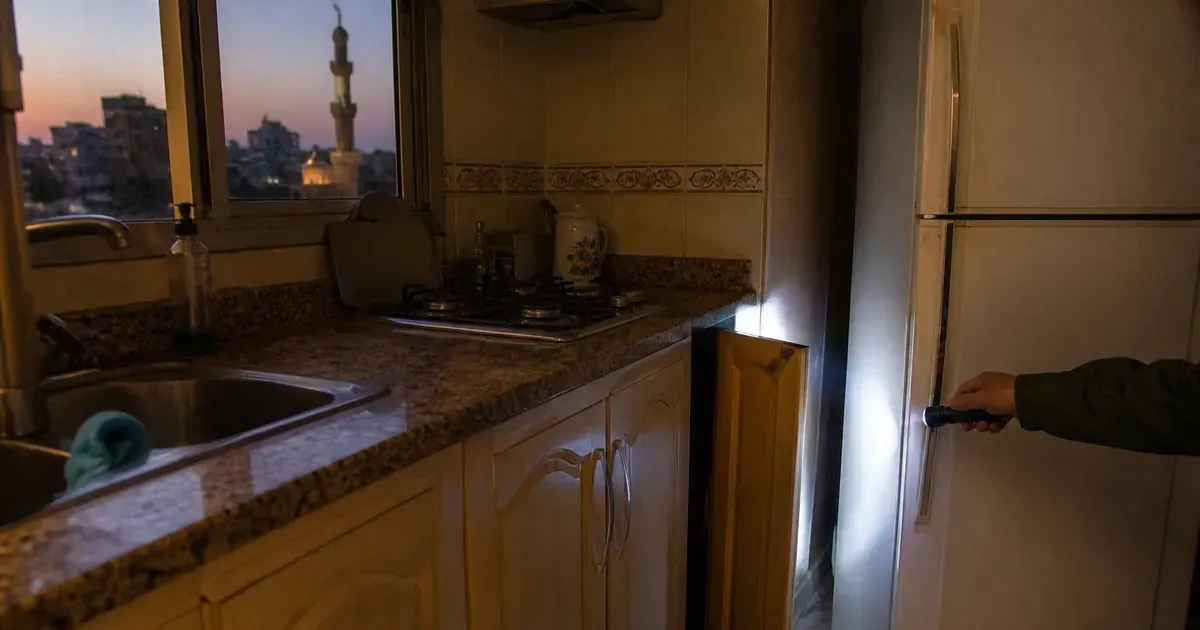
“I sprayed, they went quiet for a week, then came back in the same numbers.” That sentence reaches us by phone almost every day, in that exact order. And it has a single answer, known in entomology long before any pest control company existed in Egypt: the spray acts on the individuals that happened to be outside the harbourage at that particular moment.
What follows is about one insect: the German cockroach, the one that lives inside kitchens. We will work through its life cycle, where its harbourage is, and how it feeds — and see how every point in that behaviour explains how a thorough spray can pass over it without leaving a mark.
Why do cockroaches come back after spraying?
Cockroaches come back after spraying because the product contacts exposed surfaces and the individuals visible on them at the moment of spraying, while the larger part of the colony — and all of the eggs — is wedged into narrow voids the product never reached. What you watched drop to the floor was the minority that happened to be active at that moment.
In numbers. The German cockroach is nocturnal and spends between two thirds and three quarters of its day completely still inside a narrow crack, coming out to feed and drink in a short window hours after the lights go off. So whenever you spray the kitchen, the proportion you see and reach is a small fraction of what is sitting behind the cabinet carcass ten centimetres away from you.
The reasons the numbers return after two or three weeks come down to five, and each stands on its own even if the other four are solved:
- 1 · The harbourage itself was never reached, so the individuals inside came out after the surface residue had weakened
- 2 · The egg case is carried on the female’s abdomen and protected by a shell, so any contact product passes over it
- 3 · Most commercially available sprays are repellent, so they scatter the colony to new places instead of ending it
- 4 · If the source is a shared drainage network, entry is renewed from outside the boundary of the unit
- 5 · Sub-lethal doses filter out the weaker individuals and leave the stronger ones to breed
All five are broken down below. But the most important by far is the second, and it is the one most people have never heard of.
What is the German cockroach life cycle?
The German cockroach passes through three stages: an egg inside a case, a nymph that moults several times, and an adult. The first stage decides the entire question, because the female carries the case with her until it is nearly ready to hatch.
In most other cockroach species the female glues the case into a hidden spot a day or two after it forms and leaves it. The German cockroach female keeps walking with the case attached to the end of her abdomen for the whole incubation period. The result is that the eggs are mobile: they go into the crack with the mother, and they stay away from any treated surface by the same instinct that keeps the mother away. Any spray on the floor and the walls means the entire next generation passed over it in complete safety.
| Stage | Approximate duration in kitchen warmth | What a surface spray reaches |
|---|---|---|
| Egg inside the case | 2 to 4 weeks | Nothing — the shell and the mother protect it |
| Small nymph (just after hatching) | A few days inside the crack | Very rarely — it stays close to where it hatched |
| Large nymph | 6 to 10 weeks across all the moults | Partially — it comes out to feed at night |
| Breeding adult | 3 to 6 months | The visible part, and the smallest in number |
A single case carries 30 to 40 eggs on average, and a female produces 4 to 8 cases in her life. Which means one mated female who came into your flat in a grocery bag can, in theory, produce more than a hundred individuals before she dies — without counting the generation her daughters will produce.
How do you tell a nymph from an adult by eye?
The adult reaches 12 to 16 mm, is light honey-brown, and carries two dark parallel stripes running lengthways on the shield behind its head. Those stripes are the most reliable marker, and they stay visible even when the colour shifts a little.
The nymph is much smaller, darker, closer to black, has no wings at all, and carries a pale stripe down the middle of its back. If you are seeing a lot of nymphs together, that is a direct indicator that the harbourage is close and active, because a nymph by nature prefers to stay within a tight radius of where it hatched.
What is the difference between the German and the American cockroach?
The German cockroach is small and lives inside the kitchen itself; the American cockroach is roughly twice its size and comes from the drainage network outside the unit. Identifying which one you have is the first step in any serious cockroach control, because the harbourage is in a different place — and so is the method.
| Item | German cockroach | American cockroach |
|---|---|---|
| Length | 12–16 mm | 35–40 mm |
| Distinguishing mark | Two dark stripes on the shield | A yellow rim around the shield |
| Flight | No, runs fast | Glides short distances |
| Where it lives | Cabinet voids, behind the fridge, under the cooker | Drains, inspection chambers, building basements |
| Eggs per case | 30–40 | 14–16 |
| Fate of the case | Carried on the mother until hatching | Glued into a hidden spot after a day or two |
| Full generation time | Two to three months | 6 months to a year and a half |
| How it shows up at your place | A group scattering when the light goes on | One large individual alone, usually at night |
That table shows something important: the American species breeds far more slowly, so if you are seeing one large individual every few days, it is most likely a visitor that came up a pipe rather than a colony established at your place. That visitor is dealt with by sealing the entry point before anything else.
And the reverse follows the same logic: if you are seeing a small group running towards the cabinet joints when you turn the light on, the colony is inside your unit, and any work on the drain alone will leave the problem exactly where it is.
And what if both species show up together?
It happens, and then you have two routes that need treating at the same time. It is a common situation in older buildings with a kitchen adjoining a vertical drainage stack: the drain lets in the large species, the kitchen itself hosts a colony of the small one, and the two have nothing to do with each other beyond sharing an address.
Where is the cockroach harbourage inside a flat?
The German cockroach harbourage is not one point but a set of narrow voids that combine three conditions in the same place: steady warmth, moisture, and a surface touching the insect’s back and belly at the same time. That third condition is called thigmotaxis, and it is what explains why the harbourage is always a crack rather than an open corner.
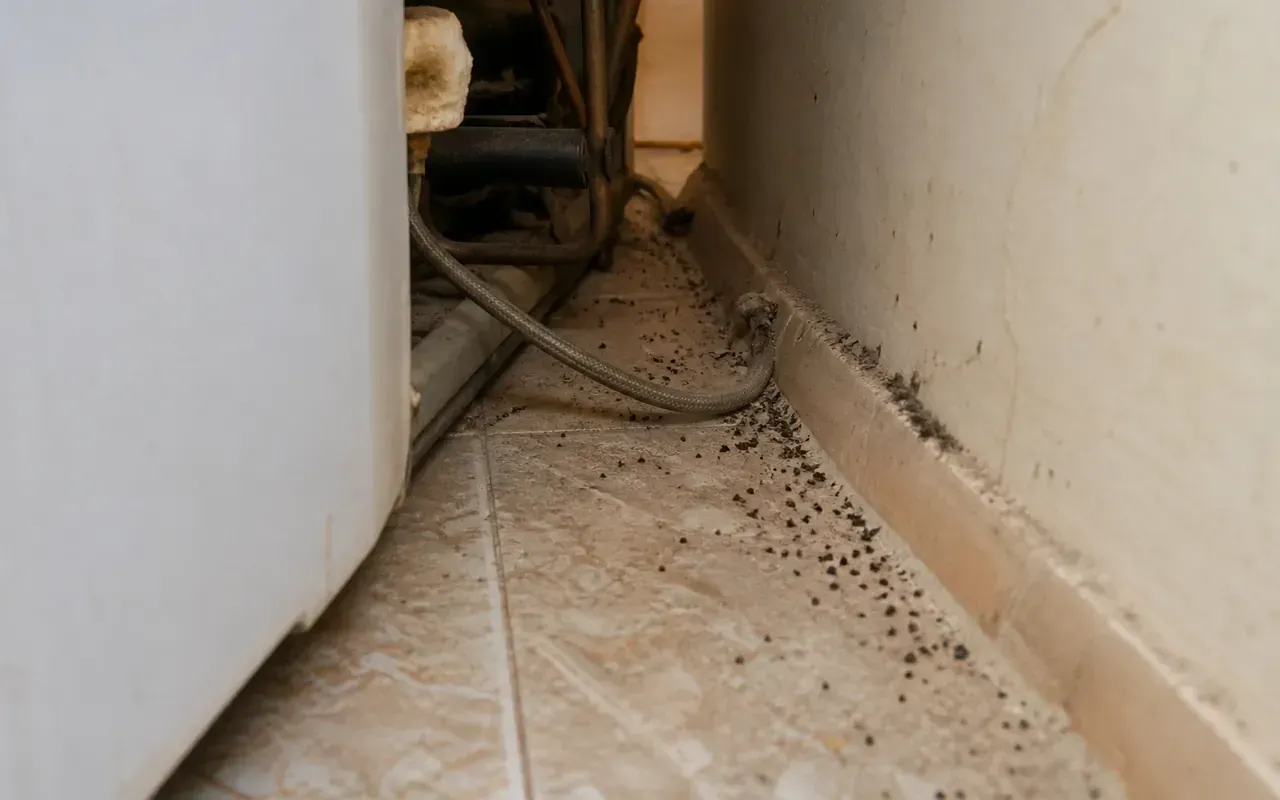
The void behind the fridge: continuous warmth, with black specks collecting at the base of the wall.
The insect feels safe when its body is touched from above and below. That is why a crack under 2 mm wide beats a wide void by a long way: an adult can wedge itself into less than 2 mm, and a small nymph passes through less than a millimetre. That figure alone rules out any idea of “spraying the cracks from outside” — the spray throws product at the mouth of the crack while the insect sits several centimetres inside it.
Why behind the fridge and under the cooker specifically?
Because those are two heat sources running around the clock in a kitchen. The fridge motor at the back provides a continuously warm space, and the void under the cooker collects dripped fats that are a complete food source. The range the German cockroach prefers is roughly 25 to 33°C — exactly what you find behind those appliances in Cairo all year round.
The same logic applies to places nobody thinks about: the void behind a water heater, the underside of a microwave, a coffee machine, the dishwasher sump, and the sides of the cupboard under the sink. That last one in particular combines warmth and moisture, which makes it the highest-density point in most flats.
The droppings are not dirt, they are a chemical signal
The small black specks you find inside drawers or on the sides of the cabinet carcass contain an aggregation pheromone. The insect reads that pheromone and learns from it that the place has been tried and is safe, so it settles there. Which means a patch of droppings is an address written in chemistry, and its presence in a particular spot is evidence that the spot is occupied for long hours every day.
And that explains something that happens often: after a deep clean of the kitchen, people notice the cockroaches have “moved” somewhere else. What happened is that the chemical signal was wiped from one point and became relatively stronger at another, so the aggregation shifted towards it.
And what does an oily smell in the cupboard mean?
That smell is produced by the insect’s glands and by droppings accumulating in an enclosed space. When it is clearly noticeable without putting your nose to the timber, the density is high and the infestation is old. The human nose picks that smell up only above a certain population threshold, so it is a late indicator rather than an early one.
What does it mean to see a cockroach in broad daylight?
Seeing a German cockroach walking across an exposed surface in daylight indicates that the harbourages are full. This insect is programmed to disappear during the day, and coming out in the light means the place it is supposed to hide in has become crowded enough that the weaker individuals were pushed out by competition for space and food — or that something disturbed the harbourage, such as a spray two days earlier, or a clean that involved pulling the units apart. In the first case you are looking at a high density that has been building for a long time; in the second you are looking at a colony that has scattered and is hunting for a new harbourage. Both need work directed at the harbourage itself, because in both cases what you are seeing is the result rather than the cause. And there is a rarer third reason: severe hunger after a long period with no food available can make individuals take the risk and come out during the day — which happens in a flat that was shut up for a month, whose owner comes home to find unusual activity in the kitchen.
How does gel bait reach the harbourage?
Gel bait reaches the harbourage carried inside the cockroach itself. The insect feeds at the point and returns to its crack before the product affects it, and there it either dies or passes droppings carrying the product — and the other individuals feed on those droppings and carcasses, taking their share without ever touching the original point.
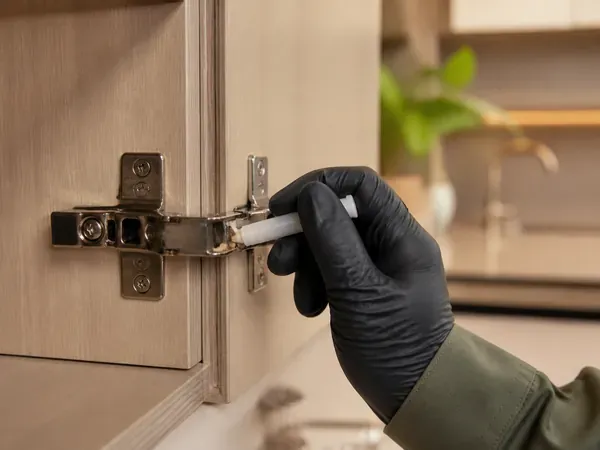
A lentil-sized gel point in the drawer hinge — the insect is what carries it to the harbourage.
That mechanism is built on documented feeding behaviour in cockroaches: small nymphs eat the droppings of adults, their shed skins, and the carcasses of colony members. And this has nothing to do with food being scarce — it is a genuine requirement. The nymph takes the gut bacteria it needs from adult droppings, and without that food it fails to thrive. Which means the weakest link in the colony — the nymph deep in the crack that never comes out — is precisely the link the bait reaches most easily.
Secondary and tertiary kill
Those two terms describe what happens after the first point. Secondary kill is the death of individuals that fed on the droppings or the carcass of one that took the bait. Tertiary kill is the death of a third generation that fed on the droppings of the secondary ones. The product stays effective as it travels along that chain, and that is the fundamental difference between something that kills what it touches and something that moves through a group.
For that chain to work, the active ingredient has to be slow on purpose. If the insect died standing at the point, you would have a carcass on the counter and an intact colony. That is why the bait is designed so the individual lives long enough to get back to its harbourage.
Why many small points rather than a few large ones?
Because a single individual’s range of movement is limited. The nymph in particular moves within a narrow radius around where it hatched, so one large point in the middle of the kitchen only serves the individuals that reach it. That is why we distribute point by point: each point the size of a lentil, 30 to 40 of them depending on the kitchen, placed in cabinet joints and drawer hinges so every harbourage finds one a short distance away.
And there is a second reason: a large quantity in one place crusts over as it dries, and cockroaches refuse dried bait. A small point is eaten completely before it gets to that stage.
Why do bleach and detergent cancel out the gel?
Bleach and strongly scented cleaners make the cockroach avoid the whole point, so it stays there in form and is abandoned in fact. That is why we say it before the technician leaves: three weeks with no bleach and no spray over the points or beside them.
The call we get in this situation runs roughly like this:
— The gel you put down did not work, it has been two weeks and the activity is the same. — Right. Did you deep-clean the kitchen after the visit? — Of course, we cleared everything out the next day and wiped all the units down with bleach. — And the points the technician showed you? — They came off with the rest. We thought they were a stain.
That is the most common cause we see for a sound treatment failing. There are four things that stop the bait working, and all four happen in good faith:
- Bleach and strong disinfectants over the points or directly beside them
- Household insect spray, because it leaves a repellent residue on the same routes
- Wiping with soap and water during the weekly clean
- Moving the sticky monitors away from their fixed positions
Cleaning itself is necessary and useful, and this is an explicit invitation to keep doing it. The difference is that you clean the exposed surfaces as normal, and leave the points placed inside cabinet joints and behind appliances alone for three weeks.
Can a cockroach refuse the bait outright?
Yes, and it has been documented scientifically since the late 1980s. Populations of German cockroach emerged that avoid baits containing glucose, because their taste receptors read glucose as bitter rather than sweet. That trait is inherited and passes to the next generation, and the individuals carrying it touch the bait and walk away from it.
In practice, an excellent bait can fail with no error at all in the application, and the evidence shows in the follow-up: the points are untouched. The fix in that case is changing the bait formulation, not increasing the quantity — and that is one of the reasons rotating products is a standing rule for us rather than a reaction. The first visit and the follow-up use two different groups.
What makes the difference here is that the phenomenon is known to the technician, so at the follow-up he reads information off the points. A point eaten with activity reduced means the treatment is on track. A point eaten with activity unchanged means a higher density than expected. A point not eaten at all means either contamination by a strong smell, or refusal of the formulation.
Why is cleaning alone not enough?
Cleaning reduces how attractive the place is and improves the bait result, but it does not remove an established colony. The reason is that a colony needs three things, and cleaning works on one of them.
Why water matters more than crumbs
The most important item on that list is water, not food. A German cockroach can live for weeks without food but only a few days without water. Which means a slow leak in the kitchen sink connection that you have not noticed for a year is worth more than a whole week’s crumbs. And if the kitchen is spotless but has a permanent point of water, the colony will survive.
Five things come up repeatedly in most flats:
- A slow leak at the sink connection or in the washing machine hose, giving a steady water source in an enclosed space
- A layer of fat under the cooker and behind the fridge that the weekly clean never reaches
- Open bags of sugar, flour and rice in the cupboard
- Kitchen waste left uncovered overnight, or covered by a loose lid
- Cardboard boxes and paper bags stored under the sink
The cardboard deserves a pause. Cardboard combines both things the insect looks for: layers pressed together that provide ready-made cracks, and a starch glue between the layers that is edible. More than that, cardboard is the best-known transport route for cockroaches between places — a box from an infested store is enough to carry one female with a case, and the rest of the story is above.
Shared drainage: why treating one flat stops at 80%
In buildings where cockroaches are established in a shared drainage network, treating one flat reduces the problem by about 80% and does not end it. We state that figure before any agreement, because the source is outside the boundary of the unit, and any promise otherwise breaks within two months.
The network connects flats vertically through a single stack and horizontally through inspection chambers. It provides permanent moisture, relative warmth, and a movement route protected from any intervention. As long as activity in the network continues, your flat is a clean treated space inside an infested environment.
The drain nobody uses opens the door
There is an architectural detail that opens the door without anybody noticing: every drain outlet has a trap that holds a little water and closes the passage between the pipe and the flat. A drain that is not used — in a guest bathroom, say, or a floor gully in an old kitchen — loses that water to evaporation within weeks, the trap empties, and the pipe is open directly onto the flat. Pouring a glass of water into rarely-used drains once a week closes that door at no cost.
In this situation the work splits across three fronts: covering drain outlets with fine mesh, a dust in the sealed voids behind the units because it stays effective in a dry space that never gets cleaned, and gel at the contact points the inspection identifies. The full solution needs an agreement with the owners’ association and treatment of the whole network.
If the building has that willingness, the annual programme is the right shape for it, because it is built on periodic monitoring with a written intervention threshold rather than scattered treatments every time the problem surfaces in one flat.
How is the result measured as a number rather than a feeling?
Measurement is done with sticky paper monitors in fixed positions. We place 6 monitors on the day of the visit and count what is on them, then count again after 21 days at the same points — and the difference between the two numbers is the verdict.
That method solves a genuine perception problem. After any treatment, people either notice less because they have stopped looking, or notice more because they have become focused on it. Both produce a wrong verdict, in opposite directions, and a sticky monitor has no opinion.
And it puts a clear obligation on our side: if the follow-up count has not changed from the first count, the re-treatment is at our cost. That comparison holds only as long as the monitor stays where it was — moving it half a metre makes the two counts incomparable.
Why do we change the active ingredient between the visit and the follow-up?
Rotating stops the new generation building resistance. Using the same chemical group over and over filters the colony in one direction: individuals with natural tolerance stay alive and breed, and after two or three generations they are the majority.
The part people find surprising is that the product does not get weaker. What changes is the composition of the colony itself. And the worst thing that accelerates it is the sub-lethal dose — product that reaches the insect at a concentration that weakens it without killing it. Which means the difference between a proper treatment and one that trains the colony is not the quantity put down; it is whether what reaches the insect is genuinely enough.
The bait placed on the visit and the bait placed at the follow-up belong to two groups that work in completely different ways — one acts on one pathway in the nervous system, the other on an entirely different one. Resistance built against one has little effect on the other, and that is the whole point of rotating.
In the annual programme that rotation is organised across the year, changing the product every two visits on a written schedule instead of being a decision made on the spot.
What do cockroaches actually bring into your home?
Cockroaches carry two kinds of harm: mechanical contamination on surfaces, and allergens that accumulate in household dust. The second is the more serious one for children, and it is the less well known.
The mechanical contamination is obvious and direct. The insect moves between the drain pipe and the kitchen counter in the same night, carrying on its legs and body whatever stuck to it along the way. Which is why cockroaches in a kitchen are a health matter rather than a cosmetic one.
The allergens come from droppings, shed skins and the fragments of dead insects. Those proteins break down into fine particles that settle in household dust and on surfaces, and they are recognised as one of the significant triggers of asthma attacks in children living in infested homes. The important detail is that those particles remain after the last cockroach dies.
And here is an admission that has to be said plainly: eliminating the colony ends the source of contamination, but it does not clean up what accumulated beforehand. Removing that residue is cleaning work — vacuuming, wiping surfaces and the insides of cupboards — and it falls to you. Nobody can sell it to you as part of a treatment.
When does the result show after treatment?
A clear drop shows within 48 hours, and full clearance takes up to 10 days. That period is the time the product needs to travel from individual to individual along the chain described above, and any shorter figure is a promise that is not true.
On the first and second day you will notice something that may worry you: more activity than usual, and individuals appearing in the open. That is expected, because the poisoning makes movement erratic and pushes individuals out of the harbourage. Carcasses appearing in open places at this stage is a sign that the work is progressing.
From day three to day ten the numbers fall steadily. And after 21 days comes the second count, which catches the generation that was still an egg on the day of the first visit. The visit itself takes between 45 and 90 minutes, and the duration rises with the area and the number of points.
The written 3-year guarantee covers re-treatment if the same pest returns. The exception is written just as clearly: a new infestation arriving from a neighbouring flat, or with second-hand furniture brought in after treatment, is outside the coverage — because that is a new case rather than a relapse of an old one.
What changes if you put treatment off for two months?
The amount of work changes, and in some cases the nature of the problem does too. The simple arithmetic says one female produces a case roughly every month in the warmth, each case holds 30 to 40 eggs, and about half of what hatches will be females capable of breeding within two to three months. So two months of delay means a complete new generation has come into service.
Which means the number of points needing bait rises, and some of them end up in places that require dismantling parts that would not have needed it. More importantly, high density raises the chance of individuals moving into a neighbour’s flat or into the vertical stack. And then the problem shifts from internal to shared — and a shared one has a ceiling of 80%, as explained above.
There is one case where delay is acceptable: if the appearances are individual and large and show up near the bathroom every few days, it is most likely the American species, and the first intervention there is sealing the entry point. Even then, two months is time enough for a case to be glued into a nearby inspection chamber.
Which governorates do you work in?
Coverage is 27 governorates. Cairo, Giza and Qalyubia the same day with a 60-minute average, and every other governorate by an appointment agreed with you in advance. The only figure we can commit to is the Greater Cairo one — everywhere else, the distance itself is what makes the visit scheduled rather than immediate.
The inspection is at no charge, and it is what identifies the species before any treatment. The steps and the method are published on the cockroach control page.
Frequently asked questions
Will the cockroaches disappear after the first visit?
You will notice a clear drop within 48 hours, and full clearance takes up to 10 days because the bait needs time to travel through the colony. The follow-up after 21 days catches the generation that was an egg on the day of the visit, and measures the result by counting the monitors.
Can I spray myself after the gel to speed things up?
No — spraying here stops the treatment. Household spray leaves a repellent residue on the same routes, so the insect avoids the bait points instead of feeding on them. Leave the points alone for three weeks, and if you see unexpected activity, call rather than intervene.
I sprayed a week ago — can I have a treatment now?
Yes, but tell the technician at the inspection. The repellent residue from the old spray affects where the points can go, and the technician adjusts the distribution accordingly rather than placing bait in areas the cockroaches have started avoiding.
The flat is spotless — can it still have cockroaches?
Yes. Cleanliness reduces food sources, but the insect needs water and a warm crack more than it needs crumbs. A tidy flat with a small leak under the sink is a perfectly viable environment for a full colony.
The whole building has cockroaches from the drainage — what do I do?
Start with your flat knowing the ceiling is 80% in that situation. Cover the rarely-used drains and pour water into them weekly, and understand that the full solution needs an agreement with the owners’ association and treatment of the whole network.
Is there a charge for the inspection?
The inspection is at no charge, and the final price is set after it, once it is clear which species it is, how large the infestation is, and whether the source is internal or from the drainage. The difference between those two changes the number of points and the shape of the work, so pricing before the inspection would be guesswork.