
Pest control that is safe around children: place and exposure
Why the place of application decides safety more than the product does, how gel and locked bait stations work, and what changes in a home with a cat.

The word “safe” on its own says nothing about a pest control product. What does say something is three questions together: which product, where exactly it was placed, and who will touch it after the technician leaves. The parent asking “will this affect the children?” is asking about all three, and an answer that covers only one of them is an incomplete answer.
This page works through all three in order. We start with the child’s body and why it handles the same quantity differently from an adult’s, then with what it means for a product to be registered for residential use, then with the mechanics: how a bait the size of a lentil placed in a drawer hinge does work that a whole can of spray does not, why bait boxes are locked with a key, and which product comes out of the bag before a technician sets foot in a home with a cat.
And one thing is worth stating in the first paragraph because it is the question we get most: our treatment is carried out with the home fully occupied. No emptying the flat, no ventilation, no waiting hours before going back in. The reason is explained in detail below, but in short it is that the product is never put into the air or onto exposed surfaces in the first place.
Is pest control safe around children and pets?
Yes — on condition that the application is targeted inside cracks and behind appliances rather than sprayed into the air, and that the products are registered with the Egyptian Ministry of Health with approval for residential use specifically. In homes with children or animals we rely on gel and bait stations far more than on spraying, and food surfaces stay outside the calculation entirely.
That sentence contains two conditions, not one, and it is easy to take note of the first and skate past the second. The product is one thing; the place it is applied is another. Somebody can use exactly the same registered product and place it where the child meets it every day, and somebody else can use it and ensure the child never meets it at all. The difference between the two is a decision made before the kit bag is opened, and it has nothing to do with the quality of the product.
Why the same quantity affects a child’s body more
Dose in toxicology is calculated in milligrams per kilogram of body weight, and that alone turns the arithmetic upside down in a home with children. If a twelve-kilogram child touches the same quantity their seventy-five-kilogram father touched, the relative dose is roughly six times higher. That figure by itself explains why recommendations in the international literature are stricter for homes with children than for offices and warehouses.
And behind weight there are three anatomical and behavioural differences that multiply the gap:
- Skin area relative to weight. An infant’s skin area relative to body weight is roughly three times an adult’s ratio. Skin is an absorbing organ, and that ratio means the same surface contamination enters a small body with higher efficiency.
- The breathing zone. A child crawling or playing on the floor has their nose thirty to forty centimetres from the tiles. The heavier particles that settle out of a spray come to rest in exactly that layer, so the air the child breathes is not the air you breathe standing up.
- Hand-to-mouth behaviour. A child between one and three puts their hand or an object into their mouth dozens of times an hour. That behaviour converts any minor skin contamination into direct oral exposure, and that is the route that delivers the largest quantity.
- Liver enzymes are still maturing. The hepatic metabolic systems that break foreign compounds down and clear them from the body reach full efficiency gradually with age, so clearance in a small child is slower.
Pets have their own logic. A cat spends a large part of its day grooming its fur with its tongue, so anything landing on the coat becomes a full oral dose within hours — and that is the real reason a cat is treated as a distinct case in the treatment plan, before we even get to which products change because of it. A dog sniffs the ground and licks its paws less, but spends more time in the garage, the garden and the places a technician approaches with different logic from the inside of a flat.
So the question the technician builds his decision on in a home with children and animals has two halves: where exactly will this product sit, and which member of the household could meet it there?
What decides the risk: the product or where it is applied?
Risk in toxicology is the product of two terms: the toxicity of the substance multiplied by exposure to it. The first term is printed on the container, fixed in advance and unchangeable by anyone; the second is decided inside your home on the day of the visit. And because it is a product, if the second term approaches zero, the result approaches zero with it whatever the first term is. That is the logic all modern pest control in occupied homes is built on, and it is where a method called crack-and-crevice treatment came from — now the standard in occupied dwellings.
Take the two cases side by side. Someone picks up a spray can and works round the kitchen: the product distributes across the counter, the cupboard doors, the floor and the drawer handles, and the fine mist stays suspended in the air for minutes before settling onto the horizontal surfaces — which is to say, onto the places the child plays. The area contaminated here is tens of times larger than the area the insect actually occupies.
And the German cockroach never sits on the counter surface. This insect has a behavioural trait called thigmotaxis: it wants its body touching at least two surfaces at the same time, so it hunts for the narrowest crack that will hold it and spends most of the day in it. That place is inside the drawer hinge, in the void behind the fridge, and under the kitchen sink where the pipes enter. What happens in that crack is what decides the outcome of the treatment, and the counter has nothing to do with it at all.
So when we say 30 to 40 lentil-sized gel points go into the cabinet joints and the drawer hinges, we are talking about a total quantity of product far smaller than a single can of spray, placed in enclosed spaces you do not see in your ordinary day.
The three routes of exposure
The product reaches a child’s or an animal’s body by three routes only: by mouth, through the skin, or through the air. Each route has a specific thing that opens it in a home, and a specific decision in the treatment that closes it.
| Route | How it happens in a home with children | What closes it in a professional treatment |
|---|---|---|
| Oral | A hand touched a surface and went into the mouth · a cat groomed its fur · exposed bait on the floor | The bait sits inside a locked box, and the gel inside an enclosed void |
| Dermal | Playing on a floor that was sprayed · sitting on a sofa sprayed from above | The product goes into the crack and the travel route; the surfaces people sit on are left untouched |
| Respiratory | Mist suspended in the air after a general spray in a closed room | There is no application into the air inside the unit at all |
That table is the summary of this whole article for anyone in a hurry. Three routes, and every one of them is closed by a decision about place before it is closed by a choice of product.
What does it mean for a product to be registered and approved for residential use?
Registration means the product has an approved dossier with the regulator, and that the approval is specific to a type of setting: residential, agricultural or industrial. What most people do not know is that many products kill insects with very high efficiency and are entirely prohibited inside an occupied flat — and that prohibition has nothing to do with the product being weak. Quite the opposite.
That distinction is what creates the entire grey-market problem. The product sold in an agricultural supplies shop is designed for open ground where the air renews itself constantly, at application rates calculated per acre. The same product inside a closed bedroom with a child in it is working under conditions completely unlike the ones it was calculated for.
But let us be honest with each other: everything above is words on paper so far, and anyone on a phone can say the same two sentences. The only thing that turns it into something you can check is putting it in writing. Among the terms of the written 3-year guarantee is a written report of the steps carried out, where they were carried out, and the date of the visit. Its practical use is that if you want to ask a paediatrician or a vet, you go with a sheet of specifics rather than a general description.
| What to ask before they start | An answer that reassures | An answer that should stop you |
|---|---|---|
| What exactly will you do? | Specific steps with their locations, written into the report | “We will spray and be done” with no detail |
| Where will it go? | Cracks, cabinet joints, behind appliances, locked stations | “We will spray the whole flat” |
| What does the kitchen get? | Gel in the cracks, surfaces left as they are | Spray on the surfaces, then clean them afterwards |
| Do I get paperwork? | A report of the steps and their locations, and a follow-up call after 14 days | “We work on trust” |
And one last line so the picture is complete: approval for residential use comes with a specific approved method of application, and following that method is part of the approval itself. Registration and place work together, and either one alone leaves half the job open.
Do I have to leave the house during treatment?
No — and there is no ventilation and no waiting period before going back in. The flat stays occupied throughout the visit, and the visit itself takes 45 to 90 minutes depending on the area and the pest. The single exception is thermal fogging for mosquitoes, which is outdoor work by nature and is covered separately below.
This conversation repeats on WhatsApp in almost identical form every week:
Client: How long do we stay out after the spray?
Us: You do not go out at all. You can stay in the house while the technician works.
Client: So how many hours do we open the windows for?
Us: As on any other day. There are no ventilation instructions.
Client: What do you mean? We had someone spray last year and we sat outside until the evening and the smell stayed for two days.
Us: That is what happens with a general spray using a product that has a smell. We place gel points in the cracks and locked stations, and the products we use are odourless.
The surprise in that third reply is entirely reasonable, and it is built on a real experience many people have had. The problem is that the experience got generalised to the whole trade, so there is now a fixed expectation in the Egyptian market that treatment means evacuation, a lost day and a smell that lingers. That expectation is in fact a description of one particular application method that turned, in people’s minds, into a description of the whole craft.
And the furniture stays where it is. The technician moves whatever needs moving to reach behind the fridge or under the sink, and puts it back. No rolling up carpets, no covering rooms in plastic, no dismantling the kitchen.
How do gel and bait work instead of spraying?
A bait is a toxicant mixed into a food matrix that attracts the insect, so the insect comes to it and takes it of its own accord rather than us chasing the insect with it. That difference is trivial in appearance and enormous in result, because it confines all of the product to a point measured in millimetres and removes any need to cover any other area.
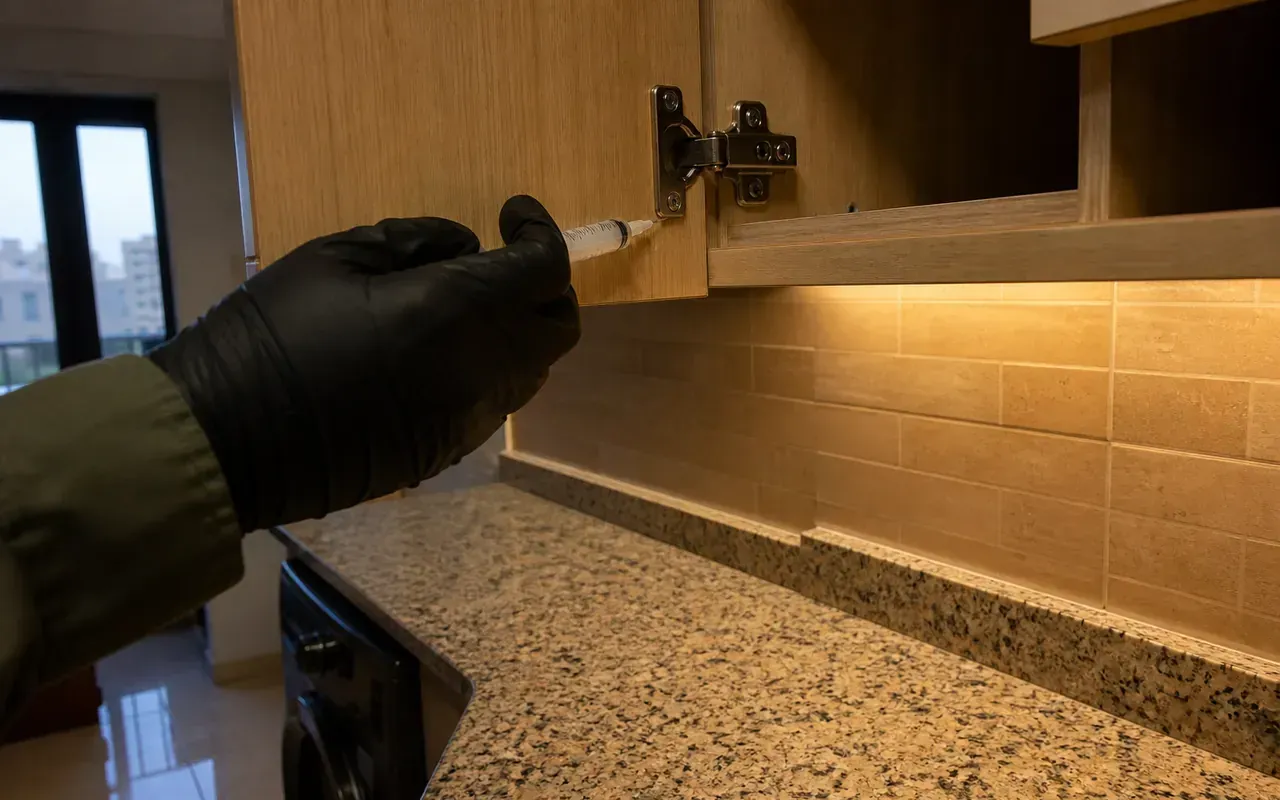
Gel points in the joints only. The food counter is never touched.
The cockroach carries the bait to the harbourage itself
The German cockroach has feeding behaviours that make it the ideal carrier of the product into the harbourage. The first is that it eats the droppings of other colony members — behaviour documented in entomology with a real function for them, because small nymphs take from it the microorganisms that help them digest their food. The second is that it eats the carcasses of its dead colony-mates. Together, those two mean the product one individual ate outside the harbourage reaches individuals inside it that never saw the gel point at all.
And that solves a fundamental problem in this insect’s biology. The female carries the egg case attached to her rear until close to hatching, and spends that period hidden in the narrowest place she can find. Which means the entire next generation is protected inside a stationary female that never comes out. A spray does not reach her, and no surface product reaches her. The bait reaches her through precisely this social transfer.
A single case produces on average between thirty and forty nymphs, and a nymph reaches breeding age within weeks in the heat of an Egyptian kitchen. If a treatment caught only the adults, the arithmetic says the numbers would be back to where they started in very little time.
Why this group of active ingredients in particular
The compound the bait is built on acts on chloride channels linked to a receptor that governs inhibitory signalling in the nervous system. When that channel is locked open, the nervous system runs with no brakes and the insect dies. What makes this compound suitable for residential use is that the shape of that receptor in insects differs from its shape in mammals, and the compound binds to the insect version far more strongly. That selectivity is a property of the molecule’s own structure — it does not come from diluting the concentration.
And we use a compound from a different group at the follow-up rather than repeating the same one, so the new generation does not build resistance. That point is not directly about safety, but it is about how many times a product will enter your home over the years.
The dust in the sealed void
The dust placed behind the units works in two ways at once: it clings to the fine hairs on the insect’s legs and body as it walks over it, and then the insect grooms itself with its mouth as it naturally does and swallows it. The dust goes into the sealed voids behind kitchen units — places that are never opened in daily use and that nobody reaches into.
And in cockroach control the result is measured on paper: 6 sticky monitors are placed at fixed points, what is on them is counted on the day of the visit and counted again at the follow-up after 21 days. The sticky monitor itself is a sheet of glue with no toxicant at all, so its presence in the kitchen adds nothing to the exposure calculation. It adds only a number you can compare.
Why are kitchen food surfaces never sprayed?
Because the target insect does not live on them, so product placed there misses its target and sits exactly where you prepare the children’s food. That decision lets the kitchen go back to normal use the moment the technician leaves — and it is the same decision that produces a better result against the insect.
But there is a second side to this that matters more, and few people talk about it.
The cockroach itself is an allergen source for children
Cockroach droppings and shed skins contain proteins recognised in the medical literature as allergens, catalogued and classified in the references. Those proteins break down over time into part of household dust, become airborne with every sweep or movement, and settle into carpets and soft furnishings. Their association with asthma attacks in children in urban housing is among the most repeatedly confirmed findings in allergy research.
The conclusion that follows is the opposite of what many people assume: parents leaving an active cockroach infestation in the kitchen “so we do not introduce products around the children” are making a choice that carries a health cost of its own — and that cost is cumulative and rises as the numbers grow. The real choice is between a measured exposure confined to enclosed gel points, and continuous daily exposure to an allergen accumulating in household dust.
And for the gel to keep working there is one instruction after treatment: no bleach and no spray over the gel points for 3 weeks. A cockroach avoids any point contaminated by the smell of a strong cleaner, so one well-intentioned wipe cancels that point’s work entirely. The rest of the kitchen is cleaned as normal.
Why are bait stations locked with a key?
The box holding rodent bait is locked with a key and fixed to the floor, creating a physical barrier between the product and a child’s hand or a cat’s mouth. A station that is neither locked nor fixed creates no such barrier — which means the difference between the two is a mechanical barrier, and the product inside both is the same.
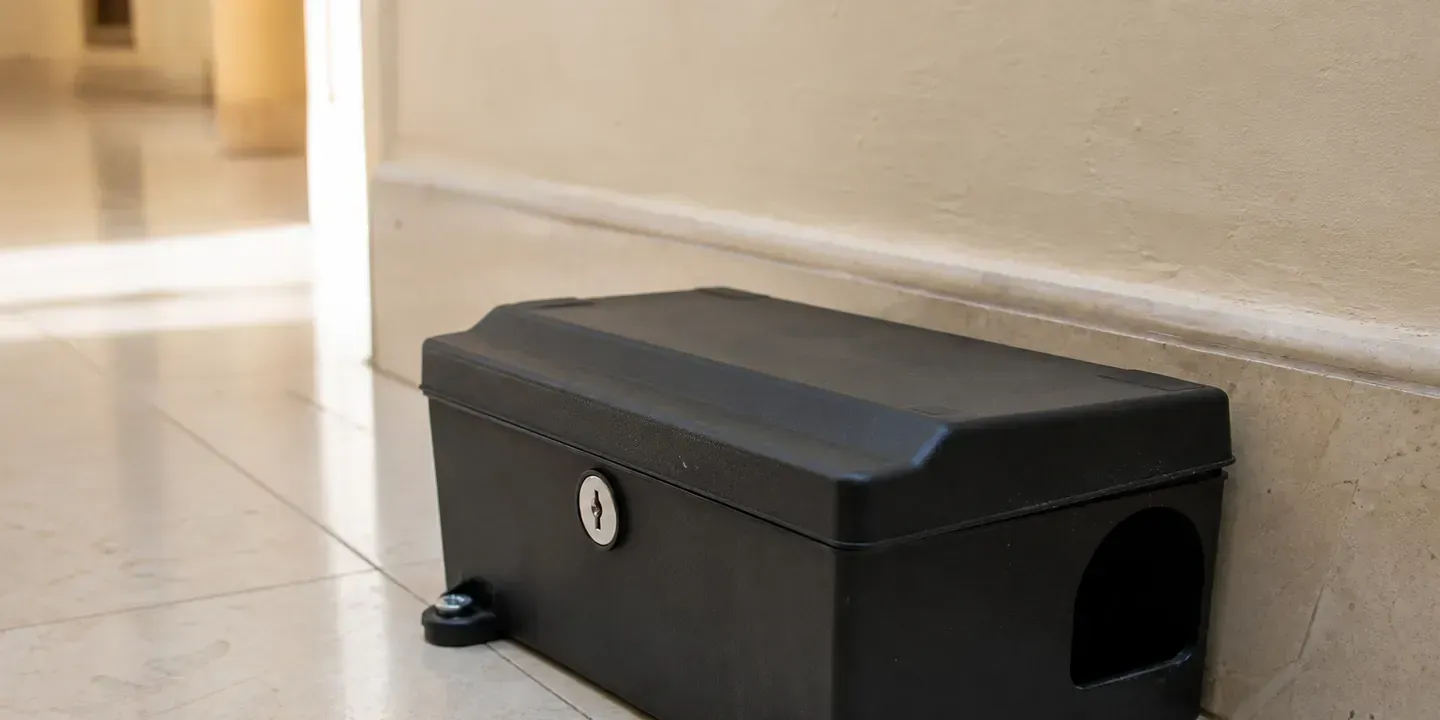
The station is locked with a key and screwed to the floor — a physical barrier between the product and a child's hand.
And that decision carries more weight in a home with children than anywhere else, for a reason rooted in the biology of the rodent itself.
The rodent tests the bait before it eats it
Rats cannot vomit. That point is purely anatomical and has an enormous behavioural consequence: an animal that cannot rid itself of something it has eaten behaves with extreme caution towards any new food. The larger species in particular approaches a new source repeatedly, takes a tiny quantity, and waits hours to see the effect on its body before coming back for a meaningful amount. That behaviour is called neophobia in the references, and it is why bait has to sit in place for days rather than minutes.
And since it is going to sit for days, its position has to be settled from the first moment. A loose box on the floor beside a wall means product available for days on end in the child’s and the cat’s space — and that is the shape that turns the treatment itself into a problem.
Why the active ingredient is deliberately slow
The bait we work with takes 4 to 7 days. That slowness is deliberate in the design. The compound is from the anticoagulant family, and its job is to stop the recycling of vitamin K inside the liver. Vitamin K is required for the liver to manufacture clotting factors, and when its cycle stops, the existing stock keeps working until it runs out — which takes days. If the compound acted within hours, the rodent watching its colleague would associate the bait with danger and abandon it, making any subsequent treatment far harder.
And the piece of information that matters to you as a parent: the recognised antidote for this group, in both human and veterinary medicine, is vitamin K1. Our work is built on the product never reaching anyone in the first place, but knowing that name is worth having.
The kitchen is a standing exception
In rodent control the kitchen receives no toxic bait at all. What goes there is mechanical and glue traps only, and that decision holds whether or not the home has children. The stations go beside the wall along the travel line itself, because a rodent walks pressed against the wall and repeats the same route every night; and in villas the work starts outside: a station every 10 metres along the boundary wall so the animal meets the bait before it enters the building.
Every station has a number and a map showing its position, and consumption is logged at every visit. That numbering means every station placed has a known location and a known consumption — no box gets forgotten in a corner. And we come back after 7 days to review the stations and seal whatever entry points remain.
And the part with no chemistry in it at all is the most important part of this whole file: the rodent comes in through a small opening around the drainage pipes or under a door, and sealing that opening with wire wool and mortar closes the route permanently. A rodent’s front teeth keep growing throughout its life at a noticeable rate, so it is obliged to gnaw constantly to wear them down — which makes timber, plastic and thermal insulation all materials it passes through, and mortar and wire not.
Are pest control products safe around cats?
There is an entire group that leaves the calculation completely. Many dogs tolerate those products without trouble, but they are toxic to cats specifically, so a home with a cat gets a different formulation from the start. For ticks and for fleas we work with an alternative registered with the Ministry of Health, and in both cases the animal walks on the surface once it has dried.
The reason for that sensitivity is known and specific: a deficiency in a biochemical pathway found in cats in particular. Most mammals clear many compounds by binding them to a sugar molecule in the liver, which makes them water-soluble so they leave in the urine. Cats have an inherited deficiency in the enzyme responsible for that step, so a compound stays active in their body far longer than in any other animal in the same house. Add to that a cat grooming its fur with its tongue for hours a day, and you have an animal taking a repeated oral dose of something its body is slow to clear.
So the question “do you have a cat in the house?” should come from the technician before he opens the bag, not from you after he has started.
| The home has | What changes | Why |
|---|---|---|
| A cat, and the problem is ticks | An alternative formulation safe for cats | The common group is toxic to cats |
| A cat, and the problem is fleas | An alternative registered with the Ministry of Health | The same reason, and we let the surface dry before the animal walks on it |
| A dog, and the problem is ticks | Veterinary treatment for the animal at the same time | Ticks spend 95% of their lives off the animal |
| A fish tank, and the problem is mosquitoes | A biological larvicide in the standing water | It hits the mosquito larva without harming fish or cats |
Two products that target a mechanism vertebrates do not have
There is a group of products that solves the safety problem at its root, simply because they target a biological mechanism present in insects and absent in humans and pets. Two of them enter our work regularly.
The first is a growth regulator placed with the treatment in flea work. It mimics juvenile hormone — a hormone insects have that governs their transition from stage to stage, and whose level must fall for a larva to become an adult. The compound makes the insect behave as though it is flooded with that hormone, so the transition stops at a point and never completes. Vertebrates have no juvenile hormone and no receptor for it, so that entire pathway does not exist in a child or a cat.
Its practical value is large in fleas specifically. The adult flea jumping in front of you on the rug is a numerical minority of the infestation; the majority is eggs, larvae and dormant pupae at the base of the pile and under the furniture, far from any spray. The treatment removes the adult, and the regulator blocks the road for the generation underneath for up to six months — which reduces the quantity of product the place needs in the first place.
The second is a biological larvicide: a bacterium that produces protein crystals, placed into standing water to hit mosquito larvae. That protein needs two conditions to work: an alkaline medium to dissolve it, and specific receptors in the gut wall for it to bind to. A mosquito larva’s gut is alkaline and carries those receptors; the stomach of a human, a cat or a fish is acidic and carries none, so the protein is broken down like any other protein in food. Which is why it goes into a fountain basin or a water tank with no calculations about what is around it.
Why is a household product more dangerous around children?
A commercially available product is applied openly onto exposed surfaces with no prior decision about place, and that raises exposure and lowers effectiveness at the same time. That second half deserves attention: higher exposure and a worse result, in the same single action.
Five actions repeat in Egyptian homes, and each one has a known consequence:
- A general spray over an open kitchen. The product sits on the counter, the cupboard doors and the floor, and the harbourage in the cabinet void receives very little of it. The exposure goes to the family and the insect gets the crumbs.
- Mixing more than one product “to make it stronger.” Mixing changes the concentration and the way the product behaves on the surface in ways nobody has calculated, and voids any meaning in the instructions printed on either container. It also makes any subsequent medical consultation harder, because nobody can say what exactly is in that place.
- Uncovered rodent bait on the floor. This is the most dangerous form possible, because the product stays available for days in the child’s and the cat’s space by virtue of being deliberately slow. The professional alternative is a locked box, and the difference between them is the box itself.
- Spraying an ant trail with a fast-acting product. The small transparent species that nests inside the flat has more than one queen per nest, and under repellent pressure small groups split off with queens and go and found new nests elsewhere — a phenomenon described in entomology as budding. The result is more nests over a wider area.
- Wiping the trail away with detergent before anyone has seen it. Ants walk on a chemical trail they lay on the surface, and wiping erases it. The insects will draw a new route within a day, and you have lost the thread that led to the nest.
That last one carries a cost to the visit itself. A technician arriving after the trail has been wiped and the cockroaches scattered from their original position needs longer to reach the same information, and sometimes reaches only part of it.
How are bed bugs treated in a child’s room?
Treating bed bugs in a child’s room relies on heat and mechanical solutions as much as on any chemical, and that has less to do with the sensitivity of the room than with the fact that those tools work better against this insect in the first place.
Steam at 90°C goes onto the mattress seams and the headboard after the technician has taken it off and inspected it. That heat is the cleanest tool in the whole job because it is finished the moment it cools and leaves nothing behind that anyone touches afterwards. After the steam comes a residual product on the cracks and travel routes, registered with the Ministry of Health and from a specifically chosen group — because the traditional group has become weak against locally established strains, and a weaker product here translates into more visits with no result.
And two things in the protocol have nothing to do with any product. A zipped mattress encasement goes on after treatment, and whatever is sealed inside dies without biting. And interceptor cups under the bed legs are there to measure: they stay between the two visits, and if activity shows on day fourteen, the re-treatment is at our cost. The two visits are 14 days apart because the generation emerging from the eggs after the first one needs a second visit to catch it.
And there is one action that doubles the problem in homes with children: someone sleeping in the living room, or carrying the mattress out of the room. Both move the infestation to the sofa and to the car, and one room becomes three places. What is asked of you before the visit is to leave the wardrobes open, and nothing else.
What is required of you before and after the visit?
Four things before the visit, all of them in the kitchen and the wardrobes:
- The kitchen surfaces cleared
- Uncovered food covered or put away
- Wardrobes left open if the treatment is for bed bugs
- The ant trail not wiped before the technician arrives
The furniture stays where it is, and there is no emptying, no covering and no rearranging.
And what falls to you after the visit depends on the pest:
- No bleach and no spray over the gel points for 3 weeks in the case of cockroaches
- Daily vacuuming for two weeks in the case of fleas — the vibration is what makes the pupae open, so the product can reach them
- The animal walks on the treated surface once it has dried
- Interceptor cups under the bed legs stay in place between the two visits in the case of bed bugs
- The zipped mattress encasement stays on after treatment
That second list is the difference between a treatment that worked and one that came back in two weeks, and we say it during the visit so it is not a surprise at the follow-up.
How do you confirm the treatment was done properly?
Every one of these can be seen with no technical background at all:
- 1 · Look at the bait station. If it is locked with a key and fixed to the floor, good. If it is a loose box on the tiles, that is something else entirely.
- 2 · Ask where the gel points are. The answer should be specific places: cabinet joints, drawer hinges, behind the fridge. If the answer is “we sprayed the kitchen,” then there is no gel at all.
- 3 · Look for the written report. A sheet listing the steps carried out, their locations and the date of the visit — one of the terms of the written guarantee.
- 4 · Ask for the monitor count. 6 sticky monitors at fixed points for cockroaches, and a numbered consumption log for the rodent stations. Whoever counts can prove the result as a number.
- 5 · Expect the follow-up call after 14 days. That is a written term in the guarantee, and it does not depend on you remembering to call.
What does the written guarantee not cover?
The written 3-year guarantee covers re-treatment if the same pest returns, along with the report and the follow-up, and it moves with you if you change address within the same governorate. Outside its coverage is a new infestation arriving from a neighbouring flat, or with second-hand furniture brought in after treatment — and it says so on the sheet itself.
And there are three other situations where we state the limit from the start:
- In a building whose shared drainage is full of cockroaches, treating one flat alone reaches a ceiling and stops there, because the source is outside its boundary. A full solution needs an agreement at building level.
- Ticks need veterinary treatment for the animal in parallel with treatment of the place. Without it the cycle returns and the treatment repeats endlessly.
- Fleas need the daily vacuuming for two weeks. The vibration is what makes the pupa open, and without it a whole generation stays protected inside it.
Frequently asked questions
These are the questions that come up on WhatsApp from homes with children or animals, in the order they usually arrive in.
When is the flat ready to use after treatment?
Immediately. There is no waiting period and no ventilation, because the application is targeted into cracks and behind appliances and the products are odourless. The only thing with any timing attached is the treated surface in tick and flea work: the animal walks on it once it has dried.
Should I wash the kitchen surfaces after treatment?
Clean the kitchen as on any other day. No product was placed on food surfaces in the first place, so there is no additional step required. The single exception is that the gel points themselves must not be wiped with bleach or spray for 3 weeks.
I have a newborn — should I delay the treatment?
Delaying makes the problem bigger in most cases, particularly with cockroaches and fleas, whose cycles complete quickly in summer heat. It is better to tell the technician at the inspection that there is a baby in the house, so the work is arranged around gel and locked stations as far as it can be.
Is the smell of a product evidence of its strength or its danger?
No, in either direction. Smell is a chemical property of the compound or of the solvent carrying it, and it has no fixed relationship to toxicity. There are products with a sharp smell and limited effect on mammals, and products with no smell at all and a far stronger effect. The products we use are odourless, and that is a description of a property in them — safety is decided by something else entirely.
Is thermal fogging done inside the flat?
No. Fogging fills a whole space with fine droplets to catch mosquitoes in flight, and that shape of work is completely different from gel and residuals. Its place is the stairwell and the voids around the building, and it is the only work carried out outside the unit rather than inside it. Its timing is calculated too: half an hour before sunset or just after dawn, the hours when mosquitoes are out and the air is still.
What does the inspection cost before treatment?
The inspection is at no charge, and there is no fee if you decide not to go ahead. It identifies the pest, the location of the problem and the scale of the infestation, and the final price follows from it, given on site before any work begins.
Do you work in my governorate?
Coverage is 27 governorates. Cairo, Giza and Qalyubia the same day with a 60-minute average, and every other governorate by a visit agreed in advance. We work from morning until late every day, with emergencies 24 hours.
Five points in summary
These are the five to remember if you did not read the whole article.
- Exposure is decided by where the product is applied before it is decided by which product it is, and all three routes — oral, dermal and respiratory — are closed by the decision about place.
- The treatment is carried out with the home occupied: no leaving, no ventilation, no waiting period, and the visit takes 45 to 90 minutes.
- The kitchen gets gel points in the cracks and mechanical traps, and food surfaces stay outside the calculation.
- Rodent bait sits inside a box locked with a key and fixed to the floor, and the kitchen receives no toxic bait at all.
- A home with a cat gets a different formulation from the start, and what was placed is written into the report.
If you have a specific question about where something would be applied in your flat, ask it at the inspection before you pay anything, and ask for the written report after the visit.